

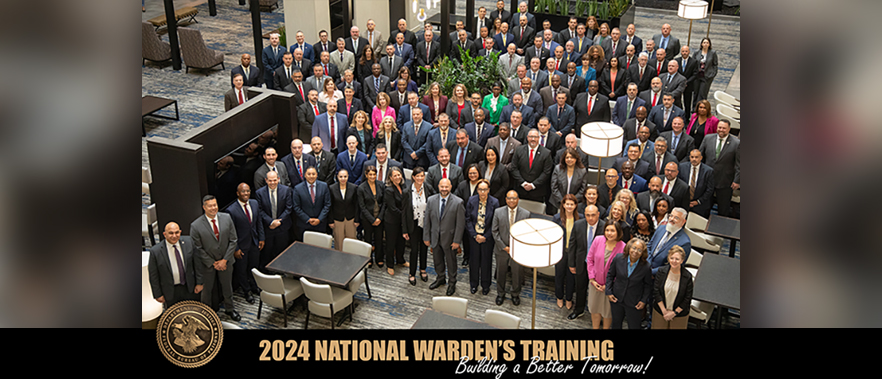
(FBOP) - The Federal Bureau of Prisons conducted National Warden's Training last week in Montgomery, Alabama. Director Colette S. Peters addressed the wardens thanking them for stepping into the leadership role and for being an integral part of the week's theme to "Build a Better Tomorrow" -- both for the institutions and the agency-at-large. In order to build a better tomorrow, we have to continue to grow as corrections professionals and as people was a key part of her message.
During Director Peters' remarks, she focused on the changes implemented this past year regarding the agency's staffing situation, and the continued exploration of options with the Deputy Attorney General and the Office of Personnel Management. Current options include identifying new tools and approaches to filling critical positions at FBOP and finding more creative solutions to manage the crisis.
Equal to the recruitment and retention crisis, Director Peters spoke about the work environments in many of our institutions being at a critical point. Healthy facility structures are essential to safety, security, and maintaining normal and humane working and living environments. Understaffing, coupled with terribly needed infrastructure repairs, negatively impacts employee wellness. She acknowledged that FBOP employees confront the challenges of understaffing every day. They are heroic and innovative; and they are also exhausted. Increasing employee numbers to reduce mandatory overtime and augmentation will help, but it is not enough.
Director Peters also spoke candidly about restrictive housing. She emphasized that restrictive housing is not an effective deterrent, does not reduce institutional-level misconduct or violence, and increases an individual's likelihood of reoffending after release. By looking at the data and what drives Special Housing Unit (SHU) placements, the Director and her Executive Team believe the most powerful reform will be normalizing and humanizing the institution environments which will help keep people out of SHU for disciplinary and protective custody reasons.
Lastly, Director Peters covered the "Framework for the Future" – the seven goals and 180 unique initiatives that focus on improving the Bureau and the working lives of dedicated employees, while enhancing the lives of the adults in our care and custody. Some of these goals and initiatives include:
Reducing the use of restrictive housing; improving both the cost and quality of health care we provide; modeling our institutions after communities; repairing and modernizing our institutions; recruiting, training, and retraining employees; and increasing our use of data to improve our decision making.
Continue hosting listening sessions, maintain the health care contract, work on restrictive housing, and actively use the 2024 hiring initiatives.
To further her message regarding the need to continue to grow as corrections professionals and as people, and the theme to build a better tomorrow, the warden's training included a session with guest speaker Bryan Stevenson. Mr. Stevenson is a public interest lawyer who has dedicated his career to helping the poor, the incarcerated, and the condemned. He is also the founder of the Equal Justice Initiative (EJI), a human rights organization committed to ending mass incarceration and excessive punishment in the United States, to challenging racial and economic injustice, and to protecting basic human rights for the most vulnerable people in American society. As part of his life's work, Mr. Stevenson and EJI, established the Legacy Sites as a place "to reckon with our history of racial injustice" where the history was actually lived.
The wardens were provided an opportunity to visit the Legacy Museum and the National Memorial for Peace and Justice. Having previously toured the Legacy Sites, Director Peters stated, "after 33 years doing this work, it was personally very powerful for me. It truly reinforced for me that while safety and security must always be top of mind, creating spaces of humanity and normalcy inside our institutions creates better public safety, better neighbors and just as important, creates a better place for our employees."
As difficult as it is to hear about and see our nation's history and our involvement as corrections professionals in the history of racism, specifically as it pertains to incarceration, it is just as critical for us to see it and acknowledge it. The past must help to inform our future. The Federal Bureau of Prisons is at an exciting moment in its own history, and from the newest employees to the institution leadership to the Executive team, each of us is an integral part of our ability to build a better tomorrow. Together we can complete initiatives, achieve our goals, and reform the Federal Bureau of Prisons.